
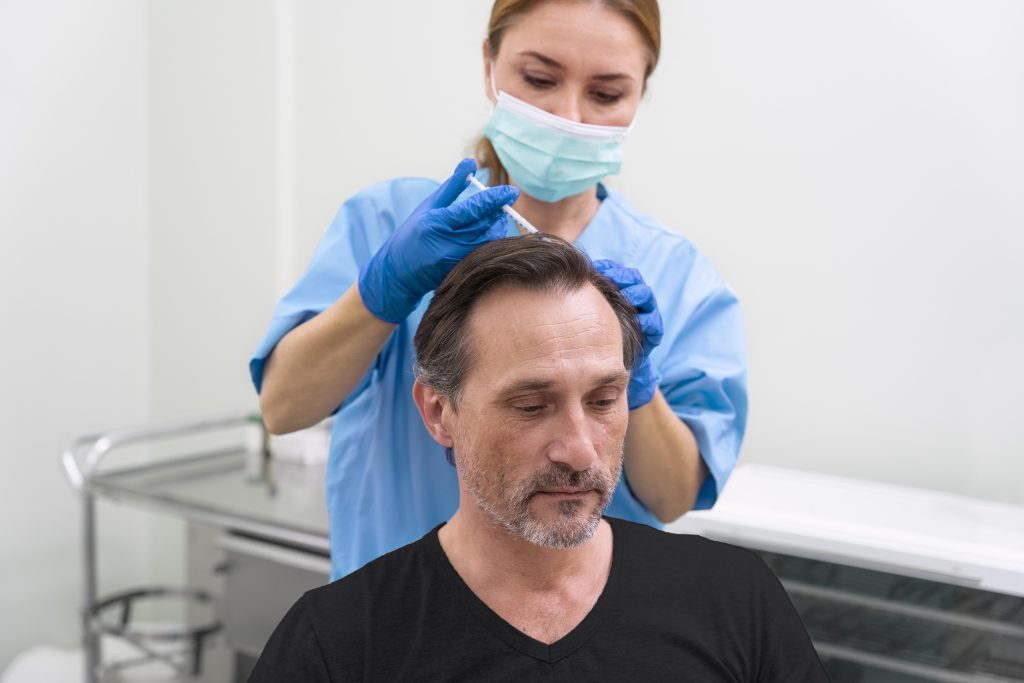
Capillaire MD specializes in advanced hair restoration, from non-invasive PRP and LED light therapy to permanent FUE hair transplants. We provide evidence-based treatments tailored to your specific requirements.
Key Takeaways
- Hair loss stems from genetics (AGA), autoimmune issues (Alopecia Areata), or temporary stressors (Telogen Effluvium).
- Platelet-Rich Plasma uses concentrated growth factors to improve hair thickness by up to 40%.
- Mesotherapy and LED light therapy offer essential nutrients and cellular stimulation with a combined approach.
- FUE hair transplants offer natural-looking, lifelong results for advanced baldness.
- Combining therapies like PRP with transplants accelerates healing and maximizes hair density.
Severe hair loss, ranging from genetic thinning to autoimmune conditions, requires specialized intervention. Clinics in Montreal offer a comprehensive approach to hair restoration, addressing causes like DHT sensitivity, stress, and hormonal imbalances. By combining clinical expertise with advanced technology, they provide tailored solutions to restore hair density and patient confidence.
Here, we explore the top-rated hair loss solutions with the best outcomes.
Understanding Severe Hair Loss: Types and Causes
Capillaire MD provides specialized care for different forms of androgenetic alopecia (AGA) in Canada. AGA is primarily driven by dihydrotestosterone (DHT) that binds to receptors in the hair follicle. H
Types of Hair Loss
Apart from AGA, we treat several types of hair loss. Here’s the list of different types of hair loss:
- Androgenetic Alopecia: Genetic thinning following predictable patterns, and is common in 70% of men.
- Alopecia Areata: An autoimmune condition causing patchy loss; we offer advanced alopecia areata treatment to calm inflammation.
- Telogen Effluvium: Temporary shedding often triggered by stress or illness.
- Traction Alopecia: Loss caused by repetitive tension on hair roots.
Reasons for Severe Hair Loss
Here are the key reasons behind severe hair loss:
- Hereditary conditions.
- Hormonal imbalances during pregnancy, menopause, or due to PCOS.
- Autoimmune diseases.
- Nutritional deficiency, such as the lack of biotin, iron, or zinc.
- Severe illnesses and emotional stress often trigger telogen effluvium.
PRP Therapy: Frontline Regenerative Treatment
PRP or Platelet-Rich Plasma hair treatment refers to a non-surgical, 3-step medical procedure, where the centrifuged blood, drawn from the patient, is injected to stimulate natural hair growth with concentrated platelets. Research shows that, as a key treatment for severe hair loss, PRP improves 30-40% of hair thickness. With 3 sessions, 3-4 weeks apart, the treatment results become visible from 3-6 months.
Here are the procedures followed in PRP therapy for hair loss in Canada.
Collection of Blood
In PRP treatment for hair loss, first, we draw a small amount of blood from the arm. It is similar to routine lab tests.
Centrifugation
The blood is placed in a centrifuge machine, and after 10 minutes of high-speed spinning, it is separated into 3 layers: platelet-poor plasma, platelet-rich plasma, and red blood cells.
Injection
The platelet-rich plasma, consisting of several growth factors that empower healing and tissue regeneration, is injected into the scalp area.
Mesotherapy & LED Light Therapy: Non-surgical Boosters
Mesotherapy and LED Light Therapy are two non-invasive, non-surgical, or minimally invasive baldness treatment procedures, which are frequently combined to improve skin quality and boost collagen.
Mesotherapy: Nutrient Boosters
Mesotherapy for hair loss in Canada involves micro-channels in the skin via microneedling, or with the use of electroporation, delivering minerals, vitamins, hyaluronic acid, or antioxidants.
- Mesotherapy, a key treatment for severe hair loss, hydrates, nourishes, and boosts collagen and elastin, which ensures a firm skin appearance and reduces fine lines.
- During a mesotherapy session, our experts inject vitamin serums in the target scalp area with 4-13 mm long needles.
- The initial hair Mesotherapy results are observed in the first few weeks, while the concrete results come within 2–3 months.
LED Light Therapy: Cellular Rejuvenation
LED (Light-Emitting Diode) light therapy is a safe and convenient baldness treatment, using specific light wavelengths to boost natural cellular processes for hair growth.
- Based on the phototherapy principle, photobiomodulation for hair loss stimulates hair bulbs for new hair growth.
- It tones the hair quality by strengthening the hair follicles, which reduces the hair loss percentage and stimulates hair growth.
- Red and infrared light options are ideal for alopecia treatment.
- With cold light, low-frequency laser therapy excludes the risks regarding burns and skin damage, later converted into hair-regenerating chemical energy.
Note: LED therapy for hair regrowth is a convenient option for women patients looking for needle-free options and who are at the early-to-moderate loss stages. However, patients with a history of skin cancer, photosensitive conditions, seizure sensitivity, or active scalp infections should not opt for this.
Combined Benefits
Here are the combined benefits of LED therapy and mesotherapy.
Enhanced Nutrient Absorption
LED light therapy enhances the absorption of amino acids, peptides, and vitamins injected into the scalp via mesotherapy. The combination stimulates dormant follicles, increasing blood flow, and accelerating the hair growth cycle.
Improved Hair Density and Thickness
While photobiomodulation stimulates cellular activities and enhances ATP production for stronger and thicker hair, mesotherapy reduces follicular miniaturization. The direct chemical nourishment by the latter, along with LED therapy, repairs and strengthens follicles from the outside.
Hair Transplant: The Permanent Solution for Advanced Baldness
A popular answer to how to stop hair loss permanently – hair transplant, under the guidance of Dr. Doumit, is an effective option to get rid of hair loss issues in Montreal, Laval, and Gatineau.
The Modern Standard: FUE Hair Transplant
For people seeking a permanent baldness solution, Follicular Unit Extraction (FUE) is a gold standard option. Unlike traditional methods, FUE harvests individual follicles directly from the donor area, and the technique ensures minimal scarring, allowing for meticulous placement to achieve natural density restoration. For patients experiencing advanced androgenetic alopecia, a hair transplant in Canada via FUE is the most convenient option to recover permanently.
Candidacy and the Capillaire MD Advantage
Ideal candidates for hair transplant fall between Norwood scale 3–6. For hair transplantation (greffe de cheveux) therapy in Montreal, CapillaireMD is a reputed clinic, distinguishing itself by integrating PRP (Platelet-Rich Plasma) therapy in the post-transplant period, ensuring the best possible results for an FUE hair transplant with this combination.
Timeline, Results, and Investment
Initially, transplanted grafts shed between weeks 2–4, and the permanent growth typically emerges by months 3–4, while you can experience a full density growth between 12–18 months. Although costs vary based on the degree of thinning and the number of grafts required, it remains a significant investment for long-term benefits.
Combination Protocols: The Multi-Therapy Advantage
The shift towards multi-therapy hair restoration in Canada reflects an advanced understanding of follicular health, and experts suggest a layered approach.
By combining PRP, mesotherapy, and LED, practitioners simultaneously trigger follicular stimulation, optimize nutrient delivery, and boost cellular energy.
Contact Capillaire MD for targeted, evidence-based combinations, as discussed below:
- PRP and LED for early-stage AGA: It leverages growth factors and light energy to thicken hair and prolong the growth phase (anagen).
- Mesotherapy and PRP for women with hormonal loss: This dual-action approach delivers essential vitamins and bioactive proteins directly to the scalp to stabilize shedding and restore density.
- FUE transplant and PRP for advanced permanent loss: Integrating PRP with surgical restoration accelerates healing and maximizes the survival rate of implanted grafts.
Since every scalp is unique, Capillaire MD’s multidisciplinary team tailors these protocols to your specific hair loss type, severity, age, and lifestyle. Schedule an appointment to determine which combination of hair loss treatment or PRP mesotherapy protocol aligns with your goals.
Contact Capillaire MD for the Best Hair Treatment and Guidance to Relive Your Youth Again!
Experiencing severe hair loss issues? Book an appointment at the Capillaire MD clinic for the best guidance and treatment at affordable prices.
Frequently Asked Questions
Q1: How Many Mesotherapy Sessions Do I Need for Hair-related Concerns?
Hair mesotherapy offers expected results in 6-8 sessions, considering 1-2 weeks apart. But in some cases, the sessions could be more or fewer than the typically recommended sessions. At Capillaire MD, you will get the best guidance from our expert, following the hair conditions.
Q2: Do I Need to Take Hair Loss Medications if I Get a Hair Transplant?
Yes, usually you need to take medicines. Since the original hair on top of the head is susceptible to DHT, without expert-recommended medications, you may lose the non-transplanted hair. So, following experts’ guidance and on-time medications is important in the post-hair transplant period.
Q3: Can Women with Severe Thinning Benefit from the Same Permanent Solutions as Men?
Yes, but the approach differs in cases of men and women. Women often experience diffuse thinning across the entire scalp, instead of a receding hairline, prevalent among men. This condition makes women better candidates for specialized FUE transplants or PEP.
Q4: Is There a Limit for Seeking Advanced Hair Loss Treatments?
Well, there is no hard upper limit for advanced hair loss treatments, but there is often a lower one. Experts generally discourage hair transplants for men in their early 20s, since their balding pattern does not stabilize during this period. For older patients (60+), the key concern is the quality and density of the donor hair available.
Q5: Is PRP therapy Effective for People Who are Already Bald?
Typically, no, since PRP (Platelet-Rich Plasma) therapy depends on the presence of existing, albeit dormant or miniaturized, hair follicles. If an area of the scalp is completely smooth and the follicles have been replaced by scar tissue, PRP does not have any target to stimulate. It is most effective for early-to-moderate thinning.
