
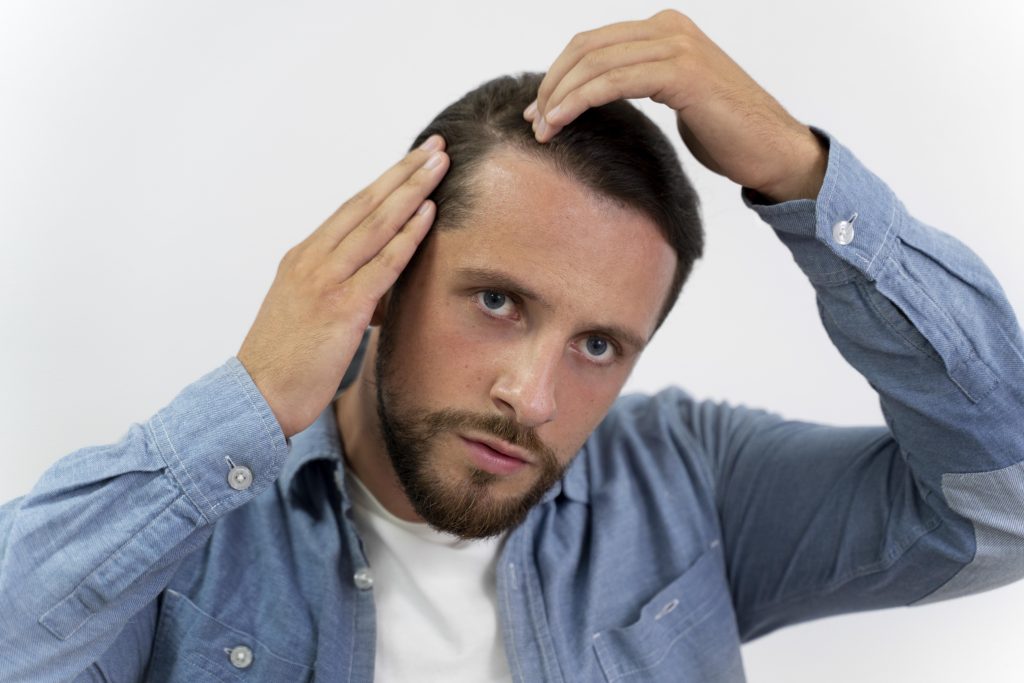
Androgenetic alopecia is a hereditary condition that is triggered by a genetic sensitivity to dihydrotestosterone (DHT). This condition is treated differently in men and women.
Key Takeaways
- The Shared Cause: Hereditary sensitivity to Dihydrotestosterone (DHT) binds to scalp follicles, progressively shortening the active growth phase and causing hairs to grow back thinner and weaker until they stop completely.
- Gender-Specific Tracking: Hair loss progression is measured on separate clinical visual metrics—the Norwood Scale tracks receding hairlines in men, while the Ludwig Scale monitors central part widening in women.
- Treatment Differences: Men primarily manage the condition using systemic DHT-blockers like Finasteride or Dutasteride, whereas women rely on anti-androgens like Spironolactone, contraceptive pills, or topical Minoxidil.
- Lifetime Commitment: Medications like Minoxidil and Finasteride manage symptoms rather than curing the condition, meaning any regrown hair will shed within a few months if treatment is discontinued.
Are you witnessing a wider part line in the mirror or a hairline that seems a bit further back? This is Androgenetic alopecia (pattern baldness) and you are not the one who is facing this as millions of people are dealing with this problem globally. This is the most common hair loss condition in Canada that affects 50% of the men and women by the age of 50.
This blog discusses the main causes and treatments for this condition in men and women.
What is Androgenetic Alopecia?
Androgenetic alopecia is a common form of hair loss in both men and women. This mainly occurs when follicles are hypersensitive to dihydrotestosterone (DHT).
DHT results in the shrinkage of hair follicles over time. This minimizes the cycle of hair growth, thereby producing shorter, thinner, and weaker hairs. Eventually, the hair follicles stop producing hair.
What are the Main Causes of Androgenetic Alopecia for Men and Women?
While the baseline biochemical pathway of Androgenetic Alopecia is identical across all genders, the specific physiological triggers diverge significantly between men and women.
The Baseline Biopathway
The process begins when the body converts standard testosterone into the more potent Dihydrotestosterone (DHT) via a native intracellular enzyme called 5-alpha reductase (5-AR). In individuals with a genetic predisposition, the androgen receptors inside the hair bulb are highly sensitive to this hormone, causing the follicle walls to slowly constrict and choke off the hair’s primary blood supply.
| Biological Triggers in Men | Biological Triggers in Women |
|---|---|
| Elevated baseline activity of the Type II 5-alpha reductase enzyme within the hair root. | Hormonal fluctuations characterized by a drop in protective estrogen levels during menopause. |
| Strong genetic correlation linked directly to the androgen receptor (AR) gene located on the X chromosome. | Underlying endocrine imbalances such as Polycystic Ovary Syndrome (PCOS), which elevate free testosterone. |
| Gradual loss of protective subcutaneous scalp fat layers over time, increasing structural tension. | Lower native levels of the aromatase enzyme, which naturally converts excess androgens into protective estrogens. |
Table: Biological Triggers for Androgenetic Alopecia
Genetics
Heredity is a primary driver of androgenetic alopecia. If you have a history of hair loss in your family, your hair follicles are genetically hypersensitive to androgens. No matter whether you are a male or a female, you can get this disease.
Hormone
Dihydrotestosterone (DHT) is the specific hormone that is responsible for pattern hair loss. This is converted from testosterone by an enzyme named 5-alpha reductase.
The Terminal-to-Vellus Shift: As Dihydrotestosterone (DHT) continuously binds to the androgen receptors within susceptible hair bulbs, it progressively shortens the active Anagen (growth) phase while extending the Kenogen (empty follicle) interval. This structural destruction forces a biological transition known as the terminal-to-vellus shift. Thick, deeply pigmented terminal hairs (the healthy strands that make up the bulk of your scalp density) are systematically downgraded with each consecutive growth cycle. The follicle produces increasingly short, fine, and clear vellus hairs (similar to peach fuzz) that lack the structural integrity to provide scalp coverage, leading directly to visible thinning.
How Androgenetic Alopecia Presents in Men
Here is what to know about androgenetic alopecia in men.
Presentation: The hairline mainly retreats at the temples. This forms an “M” or a “U” shape. You can witness progressive thinning at the crown.
Progression: This condition is clinically categorized by the Norwood Scale, which tracks hair loss in seven stages. These are:
1.Stage 1: Baseline Layout
Pre-Recession.
No visible hair loss or temple recession; the juvenile hairline remains completely intact.
2.Stage 2: Initial Movement
Adult Hairline Transition.
Minimal, symmetric recession around the temples; often flags the transition to an adult hairline.
3.Stage 3: Clinical Diagnostic Threshold
Deep Temple Recession.
Deep hairline recession at the temples forming a clear “M”, “U”, or “V” shape. This is the official threshold for active male pattern baldness.
4.Stage 4: Dual-Zone Progression
Vertex Thinning.
The frontal recession deepens significantly, accompanied by a distinct, visible bald patch expanding on the crown (vertex).
5.Stage 5: Structural Erosion
Bridge Narrowing.
The bald zones at the front and the crown grow larger, separated only by a narrowing bridge of dense hair.
6.Stage 6: Confluence of Balding Zones
Bridge Disappearance.
The strip of hair crossing the top of the scalp completely disappears, merging the front and crown balding areas into a unified zone.
7.Stage 7: Advanced Miniaturization
Horseshoe Pattern.
Advanced hair loss where only a narrow, horseshoe-shaped band of living hair remains on the sides and back of the scalp.
How Androgenetic Alopecia Presents in Women
Here are the details of androgenetic alopecia in women.
Presentation: Compared to men, women experience diffuse thinning over the top of the scalp. However, the frontal hairline is usually spared.
Progression: This Ludwig scale is used to categorize the progression of female androgenetic alopecia. The key stages include:
- Grade I (Mild): Minimal widening of the central part line. The thinning is subtle enough that it can easily be hidden with strategic hair styling.
- Grade II (Moderate): Visible, widespread reduction in hair volume and density along the central part, making the scalp clearly see-through under direct overhead light.
- Grade III (Advanced): Extensive hair density loss across the entire top of the head. The scalp is fully visible, though a thin fringe of hair along the front forehead line is preserved.
How Is Androgenetic Alopecia Diagnosed?
At Capillaire MD, we avoid guesswork by utilizing an advanced medical diagnostic screening workflow:
1. Step 1: Digital Trichoscopy Evidentiary Review
Microscopic Analysis.
Our medical team utilizes a high-magnification digital trichoscope to evaluate the scalp. If we discover a hair shaft diameter variance of greater than 20% across the thinning zone, it provides definitive clinical proof of follicle miniaturization.
2. Step 2: Scalp Mobility and Hair Pull Testing
Excluding Active Shedding.
We perform a standardized gentle hair pull test across multiple zones of the head. This diagnostic step allows us to count root structures and completely rule out acute temporary shedding conditions like Telogen Effluvium.
3. Step 3: Comprehensive Endocrine Blood Panel
Mapping Systemic Markers.
We run specialized blood tests to evaluate your internal biochemistry- measuring serum ferritin (stored iron), thyroid stimulating hormone (TSH), free testosterone levels, and fasting metabolic markers to isolate any underlying triggers.
What are the Clinically Proven Treatments for Androgenetic Alopecia?
Here are the existing treatments for men and women.
Men
The common treatments of androgenetic alopecia in men include:
Oral Finasteride & Dutasteride: These highly effective oral medications act as 5-alpha-reductase inhibitors. Finasteride blocks the Type II enzyme to lower serum DHT levels by up to 70%. Dutasteride is a more potent alternative that inhibits both Type I and Type II enzymes, lowering systemic DHT by over 90%.
Topical Finasteride Blends: To accommodate patients concerned with the rare systemic or sexual side effects of oral medications, Capillaire MD utilizes customized topical Finasteride solutions. These topical compounds target scalp DHT locally, minimizing systemic absorption.
Minoxidil (Topical & Oral): While treating the condition in men, topical 5% liquid or foam is applied to the scalp. If you do not respond to topicals, low-dose oral minoxidil is given.
Women
The common treatments for androgenetic alopecia in women are:
Spironolactone: This is an oral anti-androgen that is prescribed in 100 to 200 mg doses. This blocks androgen receptors, along with reducing testosterone production. In some cases, we often combine it with minoxidil.
Minoxidil: This FDA-approved medication for female pattern hair loss is mainly considered in the standard 2% label. Often, dermatologists suggest the 5% label for better efficacy.
Contraceptive Pills: Hormonal disorders contribute to alopecia in women. Hence, contraceptive pills are prescribed to reduce hormonal fluctuations.
Advanced Clinical & Surgical Restorations
When non-prescription or topical routines fail to hit your density goals, Capillaire MD provides advanced clinical procedures designed to rehabilitate damaged follicles:
Platelet-Rich Plasma (PRP) Therapy
During this autologous treatment, a small sample of the patient’s blood is drawn and spun in a specialized centrifuge to isolate concentrated blood platelets. When injected back into the thinning zones of the scalp, these platelets release crucial growth factors that stimulate cellular metabolism, increase local blood flow, and reverse active follicle miniaturization.
Low-Level Laser Therapy (LLLT)
A non-invasive clinical treatment that utilizes precise wavelengths of medical red light to penetrate the scalp tissue. This light energy stimulates the mitochondria within the hair cells, increasing Adenosine Triphosphate (ATP) production to extend the active growth phase of weak follicles.
Precision Hair Transplantation
For areas where the hair follicles have become completely dormant and no longer respond to medical therapies, a hair transplant provides a permanent solution. Using advanced FUE (Follicular Unit Extraction) methods, healthy, DHT-resistant hair roots are extracted from the back of the head and precisely implanted into the thinning zones. Because these transplanted roots retain their genetic resistance to DHT, they continue to grow naturally for a lifetime.
Conclusion
The root causes of androgenetic alopecia are genetics and hormonal imbalance. Apart from gender-specific topical treatments, there are certain unisex therapies like PRP and hair transplant.
Treating Androgenetic Alopecia the Right Way!
We are a renowned hair clinic in Canada. Contact your nearest clinic and consult with our dermatologists. Seek the right treatment, and get your lost hair back.
Frequently Asked Questions (FAQs)
1. What will Happen if I Stop Using Minoxidil or Finasteride?
Considering minoxidil or finasteride is not a permanent cure for androgenetic alopecia. These only work as long as you use them. As genetic hair loss is a lifelong progression, your DHT level will return to normal and your follicles will shrink again if you stop the medication. No matter how many hairs have been grown will shed within a few months if you stop it.
2. What are the Major Side Effects Associated with Finasteride or Spironolactone?
Finasteride leads to certain side effects, like erectile dysfunction or decreased libido in men. Well, spironolactone is mainly considered for women and it is mainly a blood pressure medication. The common side effects are urination, low blood pressure, dizziness, etc. However, the side effects vary from one individual to another.
3. I am Planning a Pregnancy. Do I Need to Stop Hair Loss Medications?
In short, yes. If you are planning to become pregnant, you need to avoid oral anti-androgens like Finasteride, Dutasteride, and Spironolactone entirely. This is because such medications block male hormones and can cause severe birth defects in the development of the fetus. Consult with our doctors for a pregnancy-safe alternative.
4. How Androgenetic Alopecia is Diagnosed?
At our clinic, we use a trichoscope (a medical magnifier) to look closely at your scalp and check for varying hair shaft diameters. This is the main sign of follicle miniaturization. In some cases, a ‘hair pull test’ is performed to rule out active shedding. Often, a blood test is done to check iron levels, thyroid function, and hormone balance.
5. Can using DHT-Blocking Shampoos or Caffeine Shampoos Cure Androgenetic Alopecia?
No, they cannot. Ingredients like ketoconazole (an antifungal with mild anti-androgen properties), saw palmetto, and caffeine can slightly reduce scalp surface DHT or stimulate blood flow, a shampoo only sits on your scalp for a few minutes before being rinsed away. However, they make excellent supportive additions to a hair routine.
