
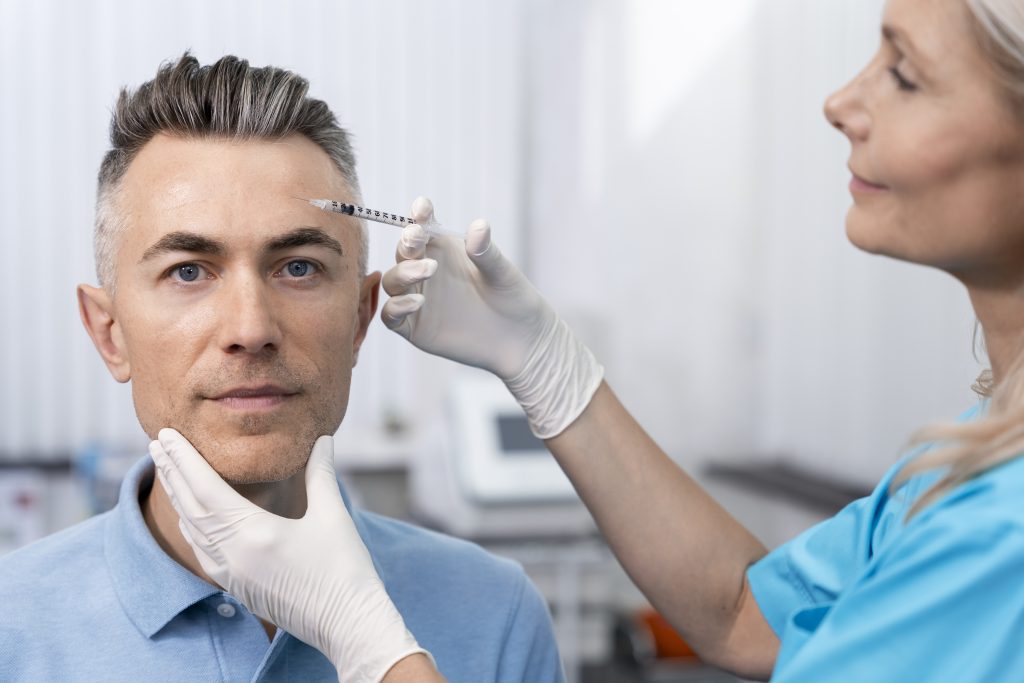
If you are in search of a low-downtime and non-invasive treatment that works on the basis of your body’s natural biology, PRP (hair plasma injection) is thought to be the most effective way to treat earlier stages of hair loss.
In the case of permanent hair loss, a hair transplant remains the only procedure that provides the possibility of hair restoration.
Losing hair causes significant emotional stress, and choosing an ineffective treatment only amplifies the frustration. Navigating options like surgery, daily medications, plasma injections, mesotherapy, and light therapy can feel overwhelming. Without proper medical guidance, selecting the wrong procedure risks wasting valuable time, money, and active hair follicles.
Key Takeaways:
- Restoration Options: Hair plasma (PRP) utilizes platelets from your own blood, triggering natural restoration of hair. Other restorative methods include hair transplants, medication, mesotherapy, and LED therapy.
- All-in-One Solution: Combination therapies often lead to a successful treatment of a person’s specific hair loss condition.
- Trust the Experts: CapillaireMD provides residents with effective hair restoration strategies.
Losing hair can be distressing. Choosing an inappropriate method would only complicate matters. PRP utilizes the person’s platelets from the blood to rejuvenate hair growth, thus creating one of the five main options for hair restoration, with other techniques being hair transplantation.
This guide compares all five, so you can walk into your consultation already knowing what fits your hair loss pattern, your budget, and your comfort with needles or surgery.
Hair Plasma Injections Compared With Other Hair Restoration Options
Hair restoration has evolved beyond traditional approaches, with several treatment options now available depending on the cause and extent of hair loss.
Before comparing PRP hair treatment (traitement cheveux prp) with other hair restoration options, let us understand what a hair plasma injection involves and how it works-
What Is Hair Plasma Injection (PRP)?
PRP therapy is a three-step medical treatment. Your blood is drawn, spun in a centrifuge to isolate the platelet-rich layer, then injected directly into the scalp.
Platelets contain growth factors. These growth factors:
- Increase blood supply to the hair follicle
- Extend the hair’s active growth phase
- Improve the thickness of existing hair shafts
- Help stabilize shedding in early-stage thinning
In Quebec and across French-speaking search, this same treatment is searched as prp cheveux, prp traitement cheveux, traitement cheveux prp, or injection plasma cheveux. It is the same procedure, just with a different search term.
A standard protocol consists of three sessions scheduled at intervals of four to six weeks, after which maintenance appointments follow after four to six months. Since PRP hair treatment (prp traitement cheveux) uses the patient’s blood, there are very few risks of allergic reactions, and most of the patients are able to resume normal functioning on the very same day.
Now let us understand how PRP is different from other hair restoration options-
- PRP vs. Hair Transplant
This is the comparison that tends to be the first searched by a majority of people and provides the best demarcation. In a hair transplant, the surgeon takes the healthy, DHT-resistant hair follicles from the back of the head and transplants them to the balding area. It is a permanent, surgical solution.
On the other hand, PRP strengthens and prolongs the life of follicles that are still active. It does not create new follicles where none exist.
| Factor | PRP (Hair Plasma Injection) | Hair Transplant |
| Invasiveness | Minimally invasive, injections only | Surgical procedure |
| Downtime | None to minimal | 5-10 days of visible healing |
| Best for | Early to moderate thinning, active follicles | Advanced baldness, bald patches |
| Permanence | Requires maintenance sessions | Permanent results in transplanted area |
| Results timeline | 3-6 months for visible change | 8-12 months for full growth |
Table 1: PRP vs. Hair Transplant
Bottom line: If your hair is thinning (rather than entirely gone), PRP can help slow down that process and thicken what is remaining.
If a portion is already bald, a transplant is the only thing that can make hair grow in that spot, but PRP is usually used in conjunction to help keep the graft alive and speed up healing.
- PRP vs. Medication (Minoxidil & Finasteride)
The two most frequent primary treatments for treating hair loss are minoxidil and finasteride.
How the medicines work: Minoxidil acts by relaxing the blood vessels in the scalp, and finasteride works by inhibiting DHT, which is the hormone that causes the hair follicles to shrink.
Key differences from PRP (PRP capillaire):
- Medications require daily, indefinite use. If you stop the application, shedding resumes. PRP requires periodic in-clinic sessions instead of a daily routine.
- Medicines have a slight probability of side effects occurring, for example, scalp irritation with minoxidil and sexual dysfunction among some users of finasteride. The system-wide side effects of PRP are smaller, as PRP requires using one’s own blood for treatment.
- Comparisons between PRP and minoxidil show that PRP is just as effective, if not more so, than minoxidil when it comes to minimizing hair loss, although the studies have been small, and there is a consensus among experts to conduct more extensive trials.
Bottom line: The most important takeaway from this is that most clinics (CapillaireMD included) obtain the best results when PRP and medications are administered together rather than being in competition with each other.
Medication acts as a steady base, and PRP helps give a periodic spike in efficiency due to the aforementioned growth factors.
- PRP vs. Mesotherapy
Both are injection-based scalp treatments, which is why they are often confused.
Mesotherapy delivers a custom cocktail of vitamins, amino acids, and micronutrients (sometimes including minoxidil) into the scalp via superficial microinjections.
PRP delivers your own concentrated growth factors, drawn from your own blood.
Here are the core differences between mesotherapy and PRP-
| Factor | Mesotherapy | PRP |
| What is injected | Vitamin/nutrient cocktail | Your own platelet-rich plasma |
| Injection depth | Superficial | Slightly deeper, targeted to follicle |
| Session length | ~20-30 minutes | ~45-60 minutes (includes blood draw & processing) |
| Best for | General scalp health, nutrient support, prevention | Stimulating regrowth in thinning areas |
| Pain level | Very low | Low to moderate |
Table 2: PRP vs. Mesotherapy
Bottom line: Mesotherapy serves as a nutritional support approach for the scalp, while PRP stands for a rejuvenating technique. They should be regarded as complementary, rather than rivals. Patients dealing with diffuse thinning often benefit from a mesotherapy foundation for scalp health, which is then further complemented with PRP for effective growth.
- PRP vs. LED/Low-Level Laser Therapy
LED and low-level laser therapy (LLLT) use red-light wavelengths to stimulate follicles from outside the scalp. No needles are involved.
How it works: Light energy is absorbed by cells in the follicle, which may improve cellular energy production and extend the hair growth cycle.
Key differences between PRP and LED therapy:
- LED is completely non-invasive, with no blood draw and no needles. But PRP requires both.
- LED typically needs frequent, ongoing sessions (often weekly, then maintenance) to sustain results. PRP’s effects tend to build with fewer, more spaced sessions.
- Evidence for LED is generally considered supportive but modest; PRP has a larger and more consistent body of clinical research behind it, particularly for androgenetic alopecia.
Bottom line: LED is a good entry point for needle-averse patients or as an add-on that extends the effect of PRP sessions between visits. Some patients pair the two for a “boost” effect.
- PRP vs. PRF (Platelet-Rich Fibrin)
A newer variation worth knowing about, even though it is less commonly asked about than the four treatments above.
PRF is processed differently from PRP, retaining more white blood cells and a fibrin matrix that releases growth factors more slowly over time. Early research suggests PRF may need fewer sessions for a comparable effect, though the difference in outcomes between PRP and PRF has not been shown to be statistically significant in most current studies.
Bottom line: Both use your own blood. PRF is essentially a slower-release version of the same concept.
Here is a comparison between PRP and other hair treatments at a glance-
Treatment | Invasive? | Downtime | Best Candidate Profile | Maintenance Required |
| PRP (Hair Plasma Injection) | Minimally | None, minimal | Early-to-moderate thinning, active follicles | Every 4- 6 months |
| Hair Transplant | Surgically | 5- 10 days | Advanced/permanent baldness | One-time (permanent) |
| Minoxidil/Finasteride | Non-invasive | None | Prevention, early stages, budget-conscious | Daily, indefinitely |
| Mesotherapy | Minimally | None | Scalp health, diffuse thinning, prevention | Every few weeks initially |
| LED/LLLT | Non-invasive | None | Needle-averse patients, adjunct therapy | Ongoing sessions |
Table 3: PRP Vs. Other Hair Restoration Treatments
Understanding how PRP compares with other hair restoration treatments makes it easier to determine which option best suits your hair loss pattern, treatment goals, and individual needs.
Which Option Is Right for You?
Use this quick self-check to narrow your options:
- “My hair is thinning, but I still have coverage everywhere.” → PRP, possibly combined with mesotherapy or medication.
- “I have a bald patch or receding hairline with no regrowth potential.” → Hair transplant, often paired with PRP for graft support.
- “I am not ready for needles or blood draws.” → Start with LED therapy or topical medication.
- “I want the fastest, most researched non-surgical option.” → PRP has the deepest clinical track record among the non-surgical options.
- “I have diffuse thinning across the whole scalp (common postpartum or with telogen effluvium).” → Mesotherapy or PRP, depending on severity; a scalp assessment will clarify which.
- “I want a permanent fix, and I am comfortable with surgery and recovery time.” → Hair transplant.
There is no single solution that fits all cases. Instead, your specific case should be evaluated based on the type of hair loss experienced, patterns, why it happened, your budget, and how much downtime you can put up with.
This is the main reason why a proper consultation of the scalp is very important, even more important than merely choosing some treatment from a list. In some cases, it may help treat hair loss more comprehensively if you combine different treatments, as a single treatment may treat specific causes of hair loss depending on one’s goals.
Can You Combine Treatments?
Yes, and for many patients, combining treatments outperforms any single option alone.
Common, well-supported combinations include:
- PRP + Mesotherapy: Regenerative growth factors plus nutrient support for the scalp environment.
- PRP + LED: Light therapy between PRP sessions to help sustain results.
- PRP + Hair Transplant: PRP before or after surgery to support healing and graft survival.
- PRP + Medication: A steady daily treatment (minoxidil/finasteride) alongside periodic in-clinic PRP boosts.
A multidisciplinary clinic that offers PRP, mesotherapy, LED, and transplant referrals under one roof is generally better positioned to build a plan around your hair loss, not around what one clinic happens to sell.
Is Hair Plasma Injection Safe? Who Should Avoid It?
PRP (injection plasma cheveux) uses your own blood, which makes it one of the lower-risk injectable treatments available. Reported side effects are generally mild: temporary scalp tenderness, minor swelling, or redness at injection sites.
PRP may not be recommended if you have:
- A platelet or blood-clotting disorder
- Active scalp infection or skin disease at the treatment site
- Certain cancers or a history of specific malignancies
- Chronic liver disease
- You are currently on blood thinners (a discussion with your provider is needed first)
This list is not exhaustive. A proper medical history review during your consultation is the only reliable way to confirm candidacy for plasma hair treatment (plasma cheveux).
Talk to a Hair Loss Specialist Before You Choose
The comparisons above are a starting point, not a diagnosis. Hair loss has multiple causes, such as androgenetic alopecia, telogen effluvium, traction alopecia, and more. The right treatment depends on identifying yours correctly.
CapillaireMD offers PRP hair treatment (PRP cheveux), mesotherapy, LED therapy, and hair transplant guidance across multiple Quebec and Ottawa-area clinics, including Montreal, Laval, Gatineau, Ouest-de-l’île, Ville Mont-Royal, Rive-Sud, Saint-Jean-sur-Richelieu, and Ottawa. Call 514-400-3291 or find your nearest clinic to get started.
In Conclusion
Hair plasma injection (PRP) uses concentrated blood platelets to stimulate active growth in thinning hair. While transplants permanently address bald patches, PRP, mesotherapy, medications, and LED therapy provide targeted, non-surgical restoration. Combining these complementary therapies under professional evaluation delivers optimal, long-term results tailored to your specific pattern of loss.
Stop Guessing Which Hair Loss Treatment Fits Your Needs
Book a personalized scalp assessment at CapillaireMD today to uncover your optimal path to fuller, healthier hair. Our expert medical team delivers science-backed, customized care across Quebec and Ottawa. Book a consultation today to get a scalp assessment and a treatment plan built around your hair, not a one-size-fits-all product. Call 514-400-3291 or visit CapillaireMD to schedule your consultation now!
Frequently Asked Questions
Q1: What If I Choose A Hair Treatment That Causes Severe Allergic Reactions, Infections, Or Unnatural Synthetic Side Effects?
Unlike synthetic options, our Hair Plasma (PRP) therapy uses a natural process that isolates platelets from your own drawn blood, virtually eliminating risks of infection, contamination, or allergic reactions.
Your therapy is safely evaluated and guided by qualified dermatologists like Dr. Joseph Doumit across our specialized clinics.
Q2: Topical Products And Oral Medications Have Not Stopped My Shedding Or Thinned Scalp Visibility. What Makes Your Clinic’s Approach Different?
We focus on targeted, localized medical therapies led by dermatologists to boost blood supply, shift follicles into active growth, and improve shaft thickness directly at the root.
We provide science-backed multidisciplinary care combining concentrated PRP, vitamin mesotherapy, and LED phototherapy to treat stubborn thinning where generic products fail.
Q3: Will I Lose The Hair I Still Have Left If My Hair Loss Treatment Goes Wrong Or Is Not Customized Correctly?
Our professional team prevents treatment errors through initial consultations. This is where our expert dermatologists assess your exact scalp pattern and active follicles before starting.
Rather than risking damage, our medical team can also safely integrate PRP with mesotherapy, LED treatment, or hair transplants to protect and nourish existing hair.
Q4: I Cannot Afford Weeks Of Recovery Time Away From Work For Hair Restoration. How Can I Treat My Thinning Hair?
Our non-surgical PRP plasma therapy and superficial mesotherapy involve minimal to no downtime, letting you resume daily activities immediately. You can easily complete a 60-90-minute session at our Montreal, Laval, Gatineau, Ottawa, or West Island clinics even during your lunch break.
Q5: I Am Getting A Hair Transplant, But I Am Worried The Newly Transplanted Grafts Will Not Take Root Or Grow Densely.
Our specialized medical team will directly combine PRP plasma injections with hair transplantation to boost graft survival rates and strengthen hair roots, with customized treatment plans.
The natural growth factors in concentrated plasma will nourish dormant follicles and improve blood circulation, helping your transplanted hair take root for denser, longer-lasting growth.
