
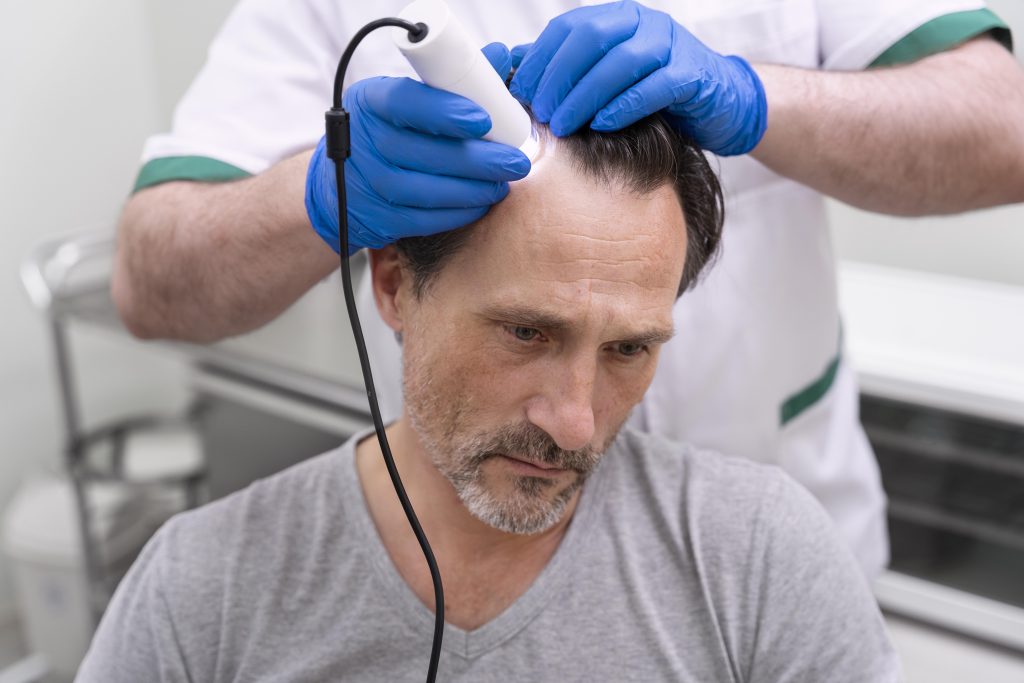
Alopecia areata is a chronic disease where the immune system mistakenly attacks the hair follicles, causing hair loss from a small area of the scalp, face, or body. This disease is not contagious, and people who have alopécie areata are generally considered healthy.
The top three treatments for alopécie areata are platelet-rich plasma (PRP) therapy, mesotherapy, and adjuvant LED.
Key Takeaways
- Alopécie areata is an autoimmune disease where the immune system mistakenly attacks the hair follicles and leads to hair loss.
- PRP therapy, LED treatment, and Mesotherapy are some effective ways to treat alopécie areata.
- Androgenetic alopecia is caused by DHT and is a genetic disorder.
What Is The Immune Privilege (IP) Collapse In The Hair Follicle?
When Immune Privilege collapses in the hair follicle, the natural protective barrier around the hair root is lost, which causes the autoimmune attack.
Usually, in a normal condition, follicles suppress the signals from the immune system and allow the hair to grow smoothly. But when the immune privilege collapses, this protection no longer works. Psychological stress and anxiety play a key role in compromising the immune privilege that allows cytotoxic T cells to attack the hair follicles and cause rapid hairfall.
What Are The Differences Between Androgenetic Alopecia (AGA) And Alopécie Areata?
Androgenetic or hormonal alopecia, commonly known as male or female pattern baldness. This genetic disorder is caused by the hormone named Dihydrotestosterone (DHT). This hormone shortens the growth phase, making the hair thinner and shorter, and ultimately leading to baldness.
Around 50% of the male and female population are affected by androgenetic alopecia. In the male population, hair loss is prominent at the frontal area, whereas in the female population, hair thinning happens mainly on the crown area.
On the other hand, alopécie areata is an autoimmune disease that happens when the immune system mistakenly attacks the hair follicles. This is a reversible condition, and most of the times are not as severe as AGA.
What Are The Best Treatments For Cheveux Pelade or Alopécie Areata?
Alopécie areata is a hair condition, which is reversible in most of the cases. Capillaire MD offers effective solutions, such as hair PRP therapy, LED treatment, and hair transplant, to treat the condition.
1. Hair PRP Therapy (Platelet Rich Plasma)
This treatment consists of three steps. At first, 8-10 ml of blood is collected from your arm and kept in a centrifuge for 10 minutes. Then, the blood is divided into three different parts: platelet-poor plasma, platelet-rich plasma, and red blood cells by a machine. After processing the blood, it is injected into the scalp, which helps to stimulate the regrowth of the hair. It increases the blood supply to the hair follicles and increases the thickness of the hair shaft.
In this treatment, a person’s own blood is used, which is considered safe for the patient.
2. LED Hair Treatment
LED phototherapy is a laser and light-based therapy that uses lights of different wavelengths that stimulate the hair follicles and promote the regrowth of the hair. This treatment is usually painless and does not have any side effects.
Red, especially cold red light, is used to treat alopecia, which penetrates the surface of the skin. It produces a very minimal amount of heat, so the chances of burning or damaging the skin are negligible.
The result of the LED hair treatment depends on the type of hair and hair loss pattern the individual has. Once the treatment is done, hair loss might stop between 2 and 4 months, while the regrowth of the hair might take up to 6 to 8 months. To get the optimal result, you might need to take several sessions of this treatment.
3. Mesotherapy
This treatment is originally used to prevent pain, but is also effective as the treatment pour pelade (treatment for alopécie areata).
In this treatment, a mixture of nutrients, antioxidants, enzymes, amino acids, vitamins, and medications is injected directly into the affected area of the scalp. It reduces the inflammation and stimulates hair growth in the patchy bald area.
Mesotherapy might take 4 to 8 sessions to provide you with the optimal result. After completing the whole treatment, you might need one maintenance session per month to sustain the result. Mesotherapy is suitable for women who lose hair due to pregnancy and childbirth. It can treat pelade des cheveux or alopecia areata up to stage IV in men, and stage II in women.
Do You Need To Take Any Precautions Before And After Taking Mesotherapy?
- Do not take medicines that can make your blood thin before getting mesotherapy.
- Wash your hair before the day of taking the treatment.
- Do not swim, use a sauna, or wash your hair for at least 48 hours after Mesotherapy to get the best result.
Mesotherapy is usually a painless hair treatment with almost zero side effects. But people who have skin rashes or allergies may face some side effects after taking the therapy.
4. Hair Transplant
To treat patchy baldness, a hair transplant can be a smart option because it gives you a more natural look. While DHT is the main hormone that causes hair loss in both males and females, not all hair follicles respond similarly to it. Usually, the hair from the back side of the head is quite DHT resistant.
So, for a hair transplant, to ensure permanent growth, these DHT-resistant hairs are used in the balding area.
The follicular units from the hair of the back of the head are carefully taken and planted in the affected area in a totally undetectable way.
There are different types of hair transplant surgery available in Capillaire MD, such as follicular unit extraction through micro-incisions, follicular unit graft, scalp reduction, or flap surgery.
In follicular unit extraction, hair follicles from the back of the head are lifted through forceps and placed in the bald area. In this particular method, visible scars are less than those of the follicular unit graft technique, hence many people prefer this method over the linear strip method.
In Capillaire MD, all types of hair transplant surgeries are performed under local anesthesia.
In this method of treatment, results are not immediately produced. You might need several surgeries to get the optimal results. However, a gap of six months is required between each session.
Looking Forward
Pelade des cheveux or alopécie areata is a treatable hair condition. Though it is a complex disease caused by an immune attack, if provided with the right treatment, like PRP therapy, LED treatment, or hair transplant, it can be treated completely.
Are You Looking For Hair Treatments For Alopécie Areata?
If you notice any symptoms of alopécie areata, contact us at Capillaire MD. We provide the best treatments for these hair conditions in Montreal.
Frequently Asked Questions
1. Can hair grow back naturally from Alopecia Areata?
Yes, within a few months, the hair might grow back naturally. It might look gray or whitish at first, but it will regain its natural color after a few months.
2. What is the difference between patchy alopecia and totalis?
In patchy alopecia, one or more than one small, round bald patches are formed on the scalp. Alopecia totalis is a more severe condition than patchy alopecia, which can lead to complete hair loss across the scalp.
3. How long does it take the treatment to work?
It depends on the condition of the alopecia areata the individual has and the type of treatment he/she is taking for it.
4. How can I manage the emotional impacts?
Alopecia can be distressing. You can join support groups or seek counselling to manage the emotional impacts.
5. Does stress cause alopecia areata?
Alopecia areata is an autoimmune disorder. While stress does not cause it directly, it might trigger the disease.
